
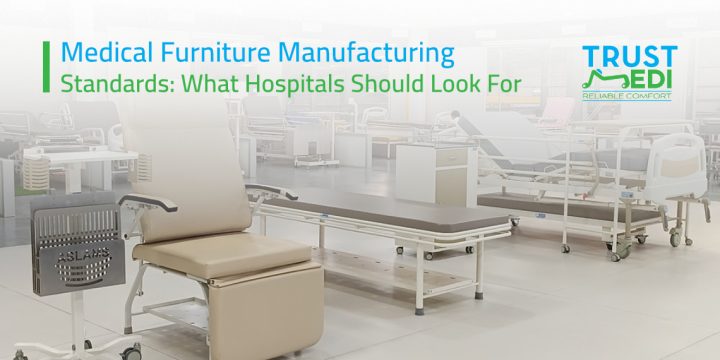
Would you approve a ward opening if the furniture fails inspection, chips after a month of cleaning, or arrives without proper documentation? That’s why Medical Furniture Manufacturing Standards: What Hospitals Should Look For is a buying topic hospitals can’t treat as “just furniture.”
In simple terms, manufacturing standards are the rules, tests, and documented controls that prove medical furniture is safe, durable, and suitable for daily hospital cleaning and patient use.
This guide explains the key Medical Furniture Manufacturing Standards, what to ask suppliers for, and how to verify compliance in real projects by trust medi.
If you’re planning a full fit-out for a hospital or clinic, start with Complete Guide to Medical Furniture for Hospitals and Clinics.
What Are Medical Furniture Manufacturing Standards?

Medical Furniture Manufacturing Standards are the technical and quality requirements used to design, build, test, and document furniture used in healthcare facilities. They often include:
- Product safety and performance requirements (mechanical stability, load limits, rail gaps for beds, locking systems, sharp-edge controls)
- Material and surface expectations (resistance to cleaners, corrosion resistance, seam design, non-porous surfaces where required)
- Factory quality controls (inspection points, traceability, corrective actions)
- Documentation rules (manuals, cleaning instructions, spare parts lists, labeling)
Hospitals also refer to Hospital Furniture Standards and Hospital Equipment Standards as umbrella terms when tenders include beds, carts, seating, cabinets, and related items.
Need Reliable Medical Furniture?
Explore Trust Medi’s product range for hospitals and clinics.
Why Standards Are Important For Hospitals?
Standards are not paperwork. They reduce day-to-day risk and long-term cost.
- Patient protection and staff safety: Poor design can create serious hazards. For example, the FDA provides guidance aimed at reducing life-threatening hospital bed entrapment risks by identifying risky openings and recommending dimensional criteria as part of a bed safety program. (fda.gov)
- Realistic cleaning requirements: High-touch surfaces in patient-care areas (including bed rails) should be cleaned and/or disinfected more frequently than low-touch surfaces, so furniture must tolerate frequent chemical exposure without degrading. (CDC)
- Project reliability: For large rollouts, standards keep deliveries consistent across batches, which matters for acceptance checks and maintenance planning. WHO highlights the importance of technical specifications before purchase to support safety and appropriate procurement decisions. (ISO)
If you’re sourcing for major Healthcare Facility Requirements (new hospitals, expansions, or multi-site upgrades), standards are what keep purchasing decisions defensible when auditors ask, “Why did you select this product?”
Before you shortlist suppliers or submit a tender, use the checklist in How to Choose the Right Hospital Bed Manufacturer for Healthcare Projects.
International Standards For Medical Furniture
Not all furniture uses the same standard set. It depends on whether the product is “non-electrical furniture” (like cabinets and carts) or “medical electrical equipment” (like many electric beds).
Key global references you’ll see in tenders:
- ISO 13485: A quality management system standard for medical devices. Many manufacturers use it to demonstrate structured controls across design and manufacturing, especially where the product is treated as a medical device in a given market. (ISO)
- IEC 60601-2-52: Applies to basic safety and essential performance of medical beds intended for adults. Hospitals often request alignment when buying electric beds or ICU beds. (ISO)
- Cleanability guidance for healthcare furniture: BIFMA’s healthcare furniture cleanability guideline is commonly referenced for how furniture materials and finishes hold up under typical cleaning/disinfection exposure (it focuses on the effect on the furniture, not whether disinfection works). (Spec Furniture)
This is where Healthcare Equipment Compliance becomes practical: hospitals choose a shortlist of standards and then require evidence (test reports, certificates, and documentation) that matches the specific product category.
For basic elevation needs without added complexity, the Half Fowler patient bed (MHB-01) fits well in general wards and recovery areas.
Safety And Patient Protection Requirements
Hospitals should ask for safety requirements that reflect real use, not showroom demos.
Examples hospitals can request:
- Stability and anti-tip behavior (especially for carts, cabinets, and tall storage)
- Load rating and proof of load testing (beds, stretchers, recliners, exam couches)
- Locking safety (casters, brakes, drawer locks, rail locks)
- Pinch-point and sharp-edge controls
- Compatibility rules for systems (bed + rail + mattress + accessories)
For hospital beds, entrapment is a well-known risk topic. FDA guidance discusses body parts at risk, identifies potential entrapment locations, and recommends dimensional criteria to reduce risk useful both for new purchases and “legacy” beds already in use. (fda.gov)
If your tender includes beds, tie your Medical Equipment Safety Standards section to clear acceptance checks: rail gaps, mattress thickness compatibility, and labeling that warns against unsafe combinations.
In OB/GYN rooms where comfort and adjustability matter, an adjustable gynecology examination bed helps streamline examinations while improving the patient experience.
Materials And Durability Standards In Medical Furniture
Hospitals don’t buy furniture for “normal wear.” They buy it for heavy loads, constant rolling, and strong cleaners.
What to look for in Medical Furniture Materials:
- Steel frames with proper corrosion protection and consistent welding
- Stainless steel where wet-cleaning and chemical exposure are constant (utility areas, procedure support)
- High-pressure laminate (HPL) or compact laminate for worktops with sealed edges
- Medical-grade coated fabrics or non-porous surfaces where appropriate, with seam construction that does not trap fluids
- Engineering plastics for bumpers and corners in high-impact areas
For Medical Furniture Durability, insist on evidence, not claims:
- Coating adhesion and resistance to cleaning chemicals
- Caster lifecycle expectations (rolling + braking)
- Drawer cycle testing for cabinets
- Upholstery resistance to cleaner exposure (for seating and exam surfaces)
BIFMA’s healthcare cleanability guideline is often used to evaluate furniture resistance to degradation from typical cleaners and disinfectants. (Spec Furniture)
That’s also the easiest way to protect Hospital Furniture Quality in real wards: pick materials that survive the cleaning schedule your facility actually follows.
Need Help Choosing Medical Furniture?
Talk to Trust Medi — we’ll help you pick the right options for your hospital or clinic.
Hygiene And Infection Control Requirements
Furniture design choices can make cleaning either fast and thorough or slow and inconsistent.
Hospitals can specify:
- Smooth surfaces, minimal seams, and accessible corners
- Reduced crevices around handles, rails, and joints
- Easy removal of parts that need deep cleaning (where relevant)
- Documented chemical compatibility lists
CDC notes that high-touch surfaces in patient-care areas should be cleaned/disinfected more frequently than low-touch surfaces, and bedrails are a classic example of a high-touch surface. (CDC)
When you compare bidders, ask them to show the cleaning instructions in the user manual. If the manual is vague, that’s a red flag for day-to-day hygiene planning.
For higher-traffic environments, a steel frame wheelchair is often preferred for its robustness and dependable daily handling.
Quality Control And Testing Processes
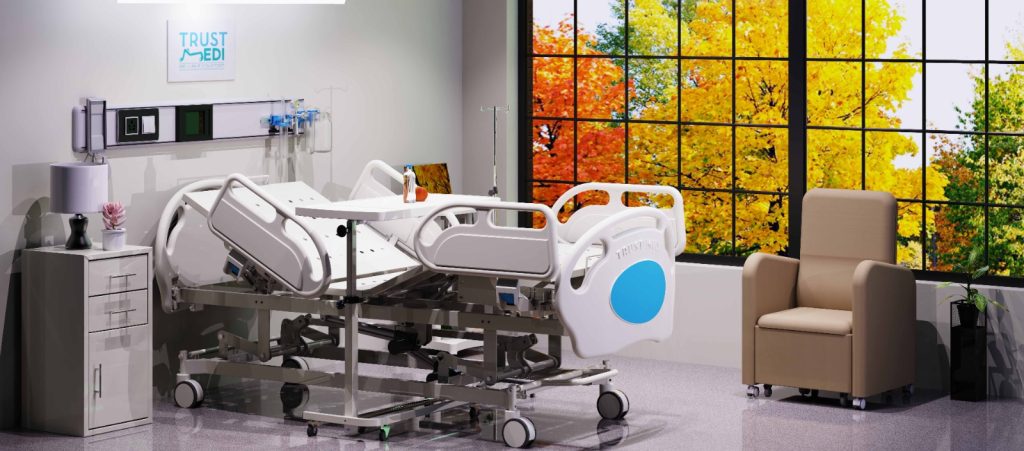
You can buy a great design and still receive inconsistent production. This is where Medical Manufacturing Compliance becomes the difference between “looks fine” and “passes acceptance.”
Quality processes hospitals should expect:
- Incoming inspection (steel grades, coatings, actuators, fasteners, casters)
- In-process checks (weld inspection, alignment, coating thickness controls)
- Final functional testing (locks, rails, height functions, brakes, electrical controls if applicable)
- Traceability (serial numbers, batch records, spare part mapping)
- CAPA (corrective and preventive actions) discipline
ISO 13485 is widely recognized for quality management in medical device design and manufacture, emphasizing controlled processes and documented requirements aligned with safety and regulatory expectations. (ISO)
Even if some furniture items are not legally classified as “medical devices” in a specific country, hospitals still benefit from vendors that run medical-grade quality systems.
For precise patient positioning and easier nursing care, the Full Fowler patient bed (MHB-02) is a practical option for wards that need flexible back and leg adjustment.
Certifications Required For Medical Furniture Manufacturers
Hospitals often ask for certificates in tenders, but the smarter approach is: certificates + scope + product evidence.
Common Medical Furniture Certifications you may request:
- ISO 13485 certificate (check scope, validity, issuing body) (ISO)
- Product-level compliance evidence for beds (often aligned with IEC 60601-2-52 for adult medical beds) (ISO)
- Cleanability / chemical resistance evaluation references (often tied to BIFMA healthcare cleanability guidance) (Spec Furniture)
When a vendor claims to be a Certified Medical Furniture Manufacturer, request:
- A certificate copy with scope that matches the products you’re buying
- A list of models covered (model numbers matter)
- Recent test reports or declarations tied to the specific item category
Also note: “ISO Medical Furniture” is a phrase buyers use loosely. Always translate it into a specific ISO standard and scope (for example ISO 13485 for QMS).
For teams shipping internationally, this covers the essentials: Hospital Furniture for Export: Compliance, Quality, and Logistics Explained.
Compliance For Local And Export Markets
Compliance changes with destination. A product acceptable in one country can face delays, relabeling, or rejection in another.
For cross-border projects, require:
- Labeling and documentation packs (manuals, maintenance schedules, spare parts lists)
- Clear conformity statements tied to your tender’s standards
- Export packaging and transport protection plan
- Warranty terms that remain valid after export
This is where supplier structure matters. Some hospitals buy direct from the factory; others buy through a local Medical Furniture Supplier that coordinates installation and service. In both cases, the compliance responsibility must be clearly written.
If you’re prioritizing durability and stability for daily clinic workload, the gynecology bed with square tubes (GB-0140) is built for consistent use and easy room integration.
Standards For Different Hospital Departments
One standard list rarely fits every department. Hospitals should match requirements to risk and use intensity.
- ICU and high dependency: beds with stronger safety controls, documented compatibility, and appropriate performance standards (often referencing IEC 60601-2-52 for adult medical beds). (ISO)
- ER and procedure zones: carts and trolleys built for heavy rolling and fast cleaning; surfaces must tolerate frequent disinfection. (CDC)
- Wards: durable bedside cabinets, overbed tables, seating, and storage that survive daily cleaning and constant use
- Isolation areas: strict cleanability focus; smooth surfaces and minimal seams become more important due to higher cleaning frequency. (CDC)
Use the department approach to write better Hospital Furniture Regulations inside your internal procurement documents: each department gets a spec annex instead of one generic spec.
How Hospitals Can Verify Manufacturer Compliance
Hospitals don’t need to “trust claims.” They can verify.
A practical verification approach:
- Request a compliance dossier for each product family (beds, carts, cabinets, seating). Include certificates, test summaries, manuals, cleaning instructions, and spare parts lists.
- Do a factory audit (or third-party audit) for large projects: QC checkpoints, traceability, calibration records.
- Run an acceptance checklist on delivery: dimensions, load labels, brake function, rail locks, finish quality, documentation completeness.
- Pilot before full rollout: put samples into real cleaning routines and real workflows for 2–4 weeks.
- Verify bed system safety: ensure rail and mattress compatibility and review entrapment guidance as part of your bed safety program. (fda.gov)
This is the fastest way to filter suppliers claiming “high quality” versus suppliers proving it.
Risks Of Non-Compliant Medical Furniture
Non-compliance does not always look dramatic at first. It often shows up as:
- Early corrosion or coating failure due to cleaning chemicals
- Loose rails, weak brakes, unstable carts
- Missing documents during inspection or accreditation
- Safety incidents (including bed entrapment risk if system compatibility is ignored) (fda.gov)
- Delayed project handover because items fail acceptance checks
Long term, non-compliance can hurt budgeting, reputation, and clinical operations.
If you want a mobility option that looks as good as it performs, this stylish patient wheelchair fits well in clinics that care about both usability and presentation.
Common Misconceptions About Medical Standards
- “ISO certificate = the product is safe.”
A QMS certificate supports process control, but hospitals still need product-specific evidence and acceptance tests. (ISO) - “Any furniture can be disinfected.”
Furniture can degrade under common disinfectants; cleanability guidance exists because materials react differently to cleaners. (Spec Furniture) - “Beds are just furniture.”
Beds are a safety system: bed frame + rails + mattress + accessories. FDA guidance exists because injuries happened. (fda.gov)
FAQ About Medical Furniture Standards
1) What standards matter most for hospital beds?
For many tenders, IEC 60601-2-52 is a key reference for adult medical bed safety and essential performance, and FDA entrapment guidance is used to guide dimensional risk checks and compatibility planning. (ISO)
2) How can we judge hospital furniture quality quickly?
Ask for cleaning compatibility, test evidence for durability, and proof of a controlled quality system such as ISO 13485 (where applicable). Then validate with a pilot and delivery acceptance checklist. (ISO)
3) Do we need cleanability standards for cabinets and carts?
Yes, because cleaning is frequent and surfaces can degrade. Healthcare cleanability guidelines exist specifically to evaluate resistance to typical cleaners/disinfectants. (Spec Furniture)
4) What’s the biggest compliance risk in real projects?
Missing documentation and inconsistent batches. Both can delay handover and create service problems after commissioning.
5) How does infection-control guidance affect furniture selection?
It pushes hospitals toward surfaces and designs that tolerate frequent cleaning of high-touch areas like bed rails and work surfaces. (CDC)
Hospitals don’t need “fancy furniture.” They need furniture that can be cleaned every day, used around the clock, and proven safe through clear documentation and testing. When you build tenders around Medical Furniture Quality Standards, verify Healthcare Equipment Compliance, and choose vendors who can prove Medical Manufacturing Compliance, you protect patients, staff, budgets, and project timelines.
If your team is preparing a tender or upgrading departments, trust medi can help you translate Medical Furniture Manufacturing Standards into a clear specification pack, shortlist a Certified Medical Furniture Manufacturer, and manage supplier evaluation from documentation to delivery acceptance. Contact trust medi to review your hospital requirements and build a standards-based procurement plan that holds up in real inspections.
